The games that Mina the Hollower is not
I was full of regret. Ten minutes up the beachhead. Trudging my way through gremlins and slimes and rebel knights. Hopelessly swinging the flail I picked out of the armory back on the ship, all I could think about were the daggers I left behind. A choice I made without enough foresight. The flail was slow out here in the open, and I was unable to land my hits up, down, left, or right as enemies flew literal circles around me. Surely if I had the speed of those daggers, I would take these monsters out before they got me down. I tried burrowing past enemies—Mina’s mechanical gimmick, arguably the game’s whole premise—but I was always midair in the animation’s initial jump when I’d get hit and knocked back. It was frustrating. I thought the flail’s range would give me some control of the space at least, some safety with distance from my targets, but it didn’t matter. I was failing to hit and to avoid being hit for the same reason, which I did not yet understand. Worse, I wasn’t having fun.1 But I knew this dance. I kept playing.
Mina the Hollower will undoubtedly be compared to the Souls games, especially Bloodborne, for how its “Plasma” lets you heal as much damage as you can deal out and for how its Bones act as a dual currency and experience point system. It’s got really good shortcuts, too, a large world that is actually smaller than it initially appears thanks to sometimes inscrutable shortcuts telegraphed on other screens. To speak in gamer lingo, exploring Mina the Hollower recalls the Metroidvania-like construction of Dark Souls 1 with Celeste levels behind every corner. But burrowing is not like a dodge role. The problem I had at the start of Mina the Hollower, both hitting and avoiding being hit by enemies, was one of perception. I wasn’t actually thinking ahead, which I knew because I was always in midair when I needed to be underground and I was always aiming where an enemy wasn’t any longer. It wasn’t an issue of speed, but of training. (I started aiming where enemies were not yet, which was also fatal.) I needed to learn to see ahead, to understand the game like a clockwork platformer and anticipate what enemies would do. I needed to learn to see the trajectory of an encounter.
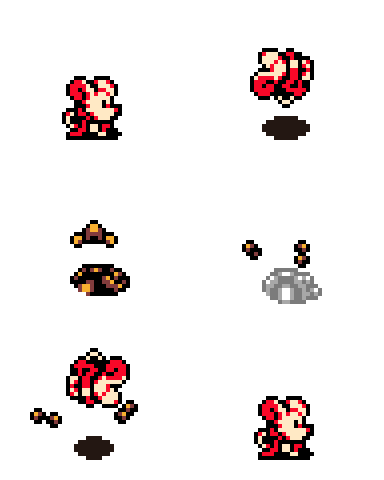
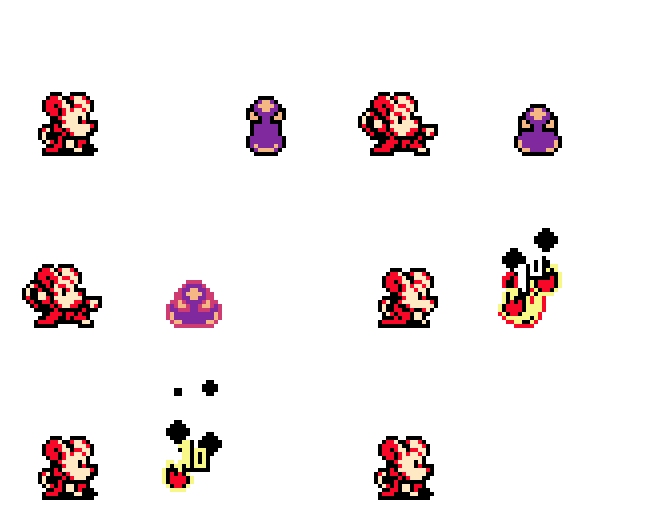
Four hours later, I didn’t miss the daggers. It took a few tries, but I beat the boss of the game’s first dungeon (a necromantic royal crypt full of mythical monsters and skeletal warriors). And about three hours after that, I beat the second dungeon’s boss on my first attempt. I had gotten it. Mostly. Enough that I was having fun. I had also adjusted by now to how depth is portrayed in the 16-bit-esque top down screens, and I was seeing patterns in the movement and attacks of different enemies. I was also thinking differently than I went in, and this is ultimately what I want out of challenge in a game—to rewire my brain in a way that changes how I behave reflexively. Mina’s burrowing mechanic carries it far because while it structurally resembles Metroidvanias and Soulslikes and adventure games, you can’t play it moment to moment like any other game.
What else can burrowing do? Well, play to find out. That’s the point, to realize what path’s have been open to you this whole time. Mina the Hollower conceals almost nothing from you, and my assumption that the purpose of its mysterious mirrors would be explained to me by a midpoint or third act reveal introducing a new mechanic betrayed the premise of the game I was actually playing. Mina and the player are given everything needed from the start, including control of the games speed and frequency of its bonfire-like checkpoints, as well as color palettes and damage modifiers and just about anything you could want to turn on or off or slide up or down. I decided not to touch these during my playthrough, to not make the game easier or harder or weirder or whatever else I wanted it to be, but even then the game is balanced around having more control as you progress. You can buy health upgrades or more trinket slots, you can chose whether the trinkets you use trivialize certain challenges or dedicate that equipment to just dealing more damage. This is why I'm not bothered by what Mina the Hollower's many modifiers mean for my experience of the game, trinkets and sidearms and upgrades are just a form of this player-centered omnipotence that is more recognizable to gamers.
You can follow my work by email or RSS feed and support my writing through Ko-fi.
As I draft this, my timeline is full of discourse treading water about weapon durability, which is framed as whether it is good or bad, period. Not good or bad in, say, Breath of the Wild (necessary, delightful) or Animal Crossing (terrible, cursed, Tom Nook in late stage capitalism). In Mina the Hollower, you can increase or decrease the frequency of checkpoints, effectively negating walk backs (none of these were actually very long). Hollow Knight: Silksong without the Last Judge walk back would be a different game entirely, one that doesn’t demand you learn the art of the nail or that severely curtails your panicked use of sidearms with scarce currencies, a game that doesn’t have a strict limit on any trinkets or abilities that ease its challenges. But as structurally similar as Mina and Silksong are as Soulslike Metroidvanias, Silksong is a game where the world only gets bigger, where the things hiding beneath the surface or in the shadows are not the truth. Where difficulty (not just challenge) actually increases despite your growing power. Because each game’s approach to walk backs is consonant with every other part of its design, I can appreciate both of these games that approach play in seemingly opposite ways.
Ultimately Mina the Hollower shares a strong foundation with these games it is not. Exploration and combat share a game-world logic that inform the design of each other, a logic that everything else flows down from. The player must identify the current, sometimes only by going directly against it. But once you figure it out, it’s a fun ride.
I worry the incredulity will not come through if you are unfamiliar with my whole deal.↩