The things you think are sins are nothing in a devil's eyes.
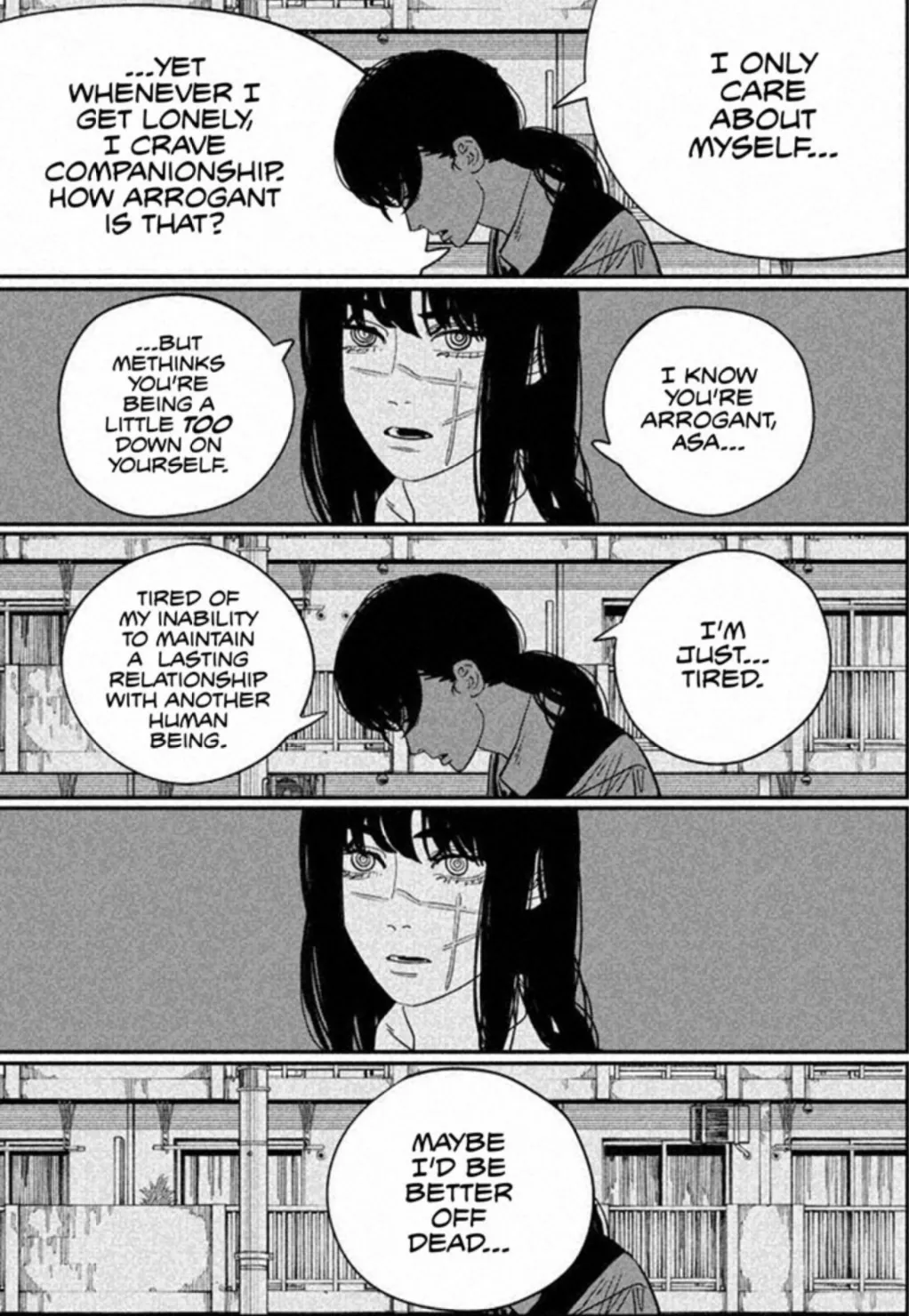
There is a single page of Chainsaw Man Part 2 I've reread more than any other in manga. It's in chapter 121. A teenage girl has just been stood up and brushed off. Her neurotic failure of a courtship devolved into a monologue of self hatred. That boy was beneath her. Of course he would want her. But here she is, alone. Her worst self looks on. When she says a life of solitude would be better than feeling this hurt, her devil looks for a moment like she may be concerned, but of course assents.
The girl continues to spiral. "I only care about myself, yet whenever I get lonely, I crave companionship. How arrogant is that?" And now even the devil talks back, tells her she's being too hard on herself. "I'm just tired," she continues, unheeding. "Tired of my inability to maintain a lasting relationship with another human being." There is a panel where even the devil can only look on. It's not with pity. Her dialogue now covers her face, her thoughts all consumed by the spiral: "Maybe I'd be better of dead..."
The page turns. She here's something. Bodies are falling. Her devil protects her.
Chapter 229 was published three years later. The girl lies bleeding out in a ruined city, staring up at a sky of doors—hell come to Earth. The titular hero of the manga, just his upper half, crawls across the street towards her. It is now the devil in the body. The girl stands over her, looking down at her own corpse bleeding out. The devil laughs and she can't understand why someone—something—so evil would ever show the smallest regard for a living thing as not hitting a bird. As they both lay dying, the devil says she tried to understand the girls guilt, “But in the end, I couldn’t comprehend it.” The page turns. Drawn like a diptych, the devil looks up from a pool of blood at the girl, two birds soaring overhead. She tells her: “The things you think are sins are nothing in a devil’s eyes.”
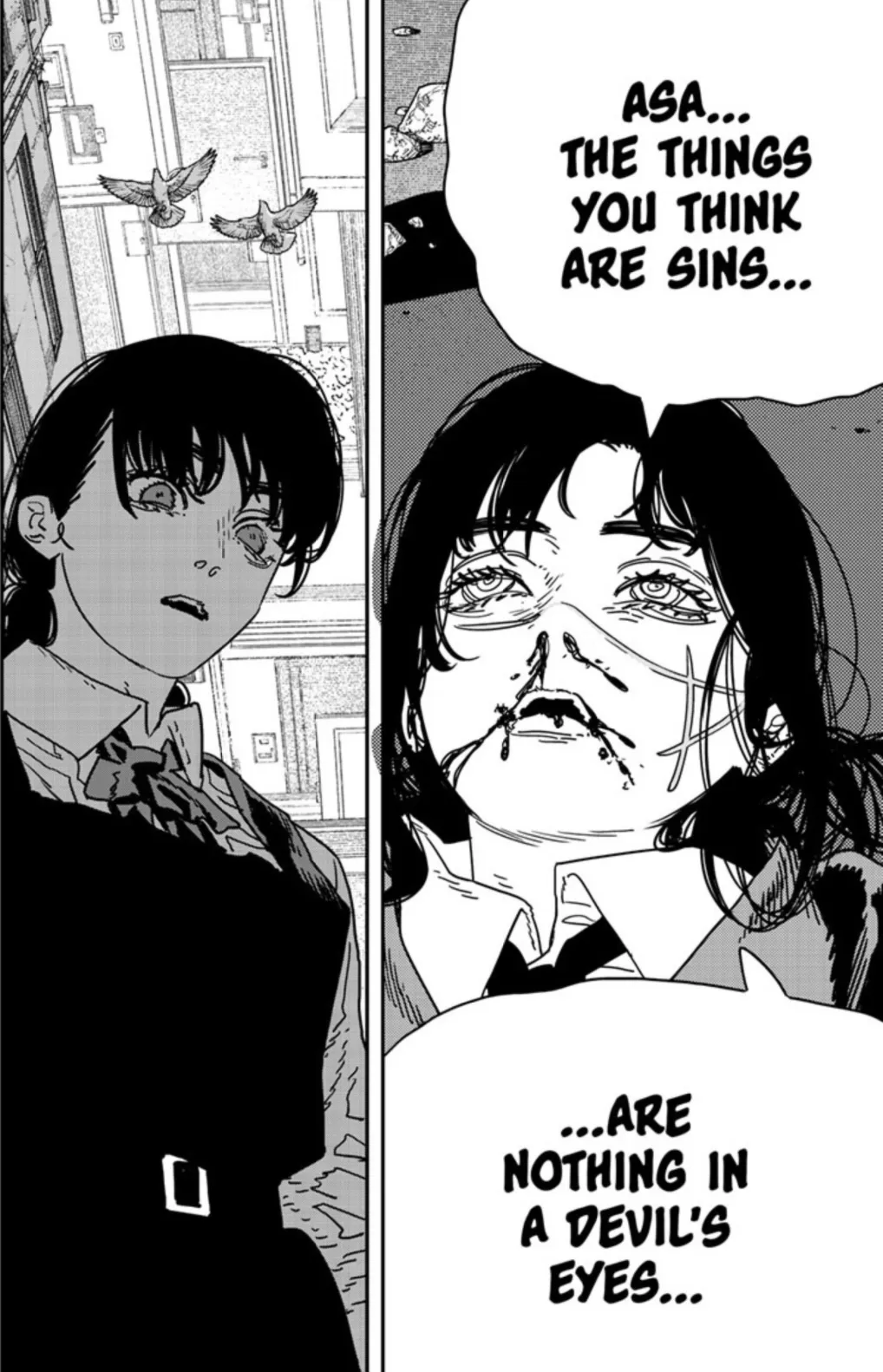
The devil imagines if those two birds could fly away thinking only happy thoughts, but the hero is here. He ruins the moment.
Chainsaw Man is a Faustian hero. While the eponym is literally gods favorite, Part 1 protagonist Denji and Part 2 protagonist Asa are presented their devils bargains at deaths door. Not much of a choice, accept or die, and that’s the point. Each character is positioned at the bottom of a world in which their lives and happiness and bodies have already been hedged. Here, the most powerful devils are not orientalized, but idealized. As Ed Simon writes in Devil’s Contract:
Never have the immoral negotiations and intransigent capitulations of our broken society been clearer, never has the light of our illusions and the sound of our spectacles been more entertaining even as the temperature rises and the shoreline disappears. Riven by its own catastrophic contradictions, the Faustocene is an age of cold rationality and fervent occultism, of unfeeling irreligiosity and zealous fundamentalism. An age marked by the ability to change and alter the world, to create illusions and demonstrate the illusions of reality itself, to finally call God’s bluff, but to establish a hell in the interim, where magic and technology become indistinguishable.
If Denji’s Chainsaw Man is the Faustian hero we need, Asa is the neurotic suicidal femcel girlfailure we deserve. Asa is constantly worried that she feels the wrong things at the wrong times. She fears she will inevitably hurts anyone close to her, and that she isn’t capable of genuinely liking someone or being liked. (She just like me, fr.) Whereas Denji’s devil is the kind canine Pochita who would see Denji realize his dreams, Asa’s devil, the War Devil, Yoru, veers closer towards a seductive, corruptive Mephistopheles. War Devil literalizes Asa’s self-destructive thoughts. She wrests control of Asa’s body: to fight or kill or kiss. Asa loses both her arms, literally her ability to feel others, which are replaced with weapon gauntlets. She fears War Devil will literally transmute her affection for others into power by turning people into physical weapons. Simon, again: “Mephistopheles remains the animating spirit of modernity as it had emerged in the nineteenth century, his motivating principle a utilitarian doctrine which sees both nature and other people as tools in the furthering of the individual’s own desires.” There is no alias for Asa to dissociate from. She is the face of the devil hunter poster-girl and the lonely school girl and the horseman of the apocalypse. Asa grows confident with this liberatory power. She falters (she always stumbles), letting it consume her. Her arc culminates by growing willed enough to resist War Devil’s destructive impulses as much as possible. But she’s only one girl.
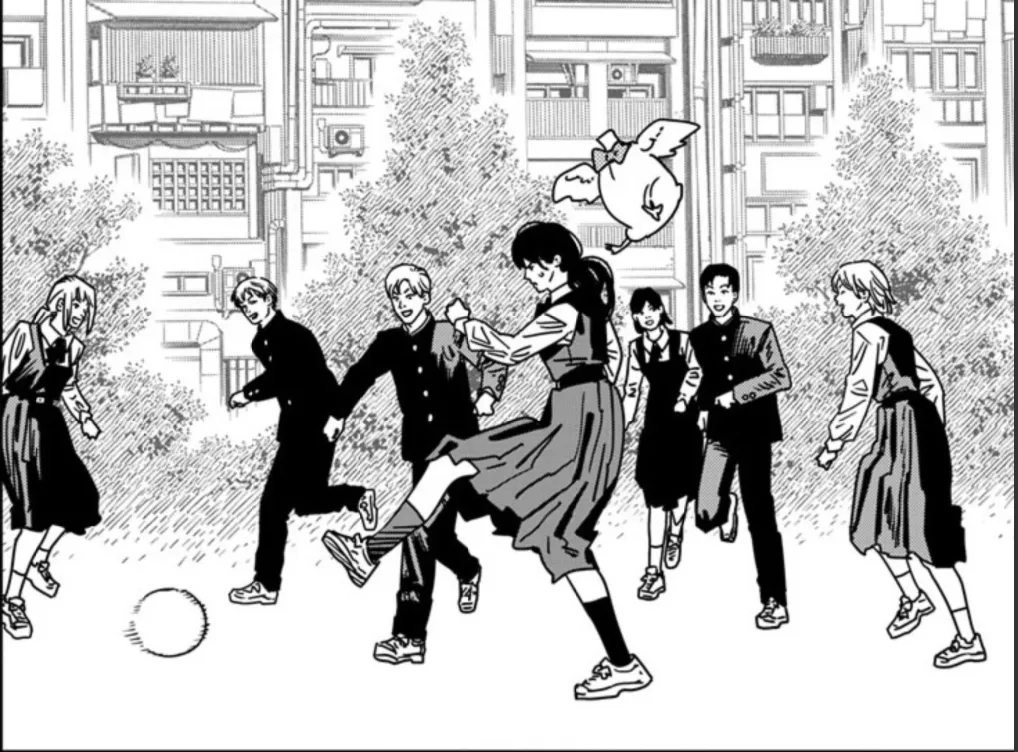
The creation of a new world at the end of Chainsaw Man does not result from Asa’s actions to resist the War Devil (presented as suicide, which narratively positions this as the wrong solution). Chainsaw Man is consumed and Denji is spirited away by Pochita. Asa, as much as she parallels Denji’s tribulations and shortcomings, is sidelined here for everyone’s favorite idiot horny boy. In its final chapter, we see how the precipitating events of each part are shifted. Power saves Denji, Denji catches Asa, Asa doesn’t kill Bucky—and she presumably runs back to play with her class and come out of her shell and make new friends. Denji saves her, and Asa runs back to the life where she helped kill her dad, blames herself for killing her mom, surrendered her cat to drown at the orphanage, and is the target of her teachers pedophilic attraction. Is he still sleeping with the class representative (as she told us in the Justice Devil arc)? Pochita says keep dreaming, but would Denji and Asa not continue to dream about the closed doors at the end of their dream alleys, the suppressed memories of their patricides? Maybe it just speaks to what Denji can hope for under these systems—not a better world, but friends. (Even then, only some. Aki is MIA.)
To make thematic sense of this abrupt conclusion would cast much of the manga as a cautionary fable. Chainsaw Man’s representation of misogyny, nationalism, and exploitation calls for resistance to the status quo, but its ending denies any action that might change it. When finding the power to shirk the adults abusing you heralds the apocalypse, the necessity of tearing down the systems built on your exploitation is denied. “The Faustian tale is one of those myths that allow a culture to project its anxieties and desires,” James Wood writes in The New Yorker. Throughout history, Faustian stories have “existed as myths that enacted both resistance and control.” They can only end one way: The devils arrive, death comes. This is just the beginning of an eternity, though, and here again Chainsaw Man gestures to subversion. Death is erased. This is genre breaking, but what comes next? What radical futurity is possible?
While the manga’s perception in the mainstream is tied up in its reputation for subversion, Chainsaw Man is not about the perversion of shonen (re:male) power fantasies. (It is subversive of shonen tropes, but the manga is not about subverted shonen tropes.) Asa is not here to make Chainsaw Man the shonen manga with a girl protagonist (the ultimate genre subversion). Rather, her character offers a different window through which to explore how gender and sexuality fester under exploitation, extraction, and injustice. There is no hero strong enough to fix this. There is no power fantasy that can escape the ills of this world. You need to get through it with friends, with the family you make. Is that a happy ending? No. But maybe it’s a little better off than where you started. Maybe you shouldn’t even dream of that better world. To imagine it might be enough to ruin what comfort you found in this one.
Simon reminds us that no matter how corrupted his desires, Faust is human. He is “not without sympathy.” At some point, Asa inherits War Devil’s weapons. She uses them. They become her own. Let me forgive her for what she did, not take away what made her a hero.