Sleepy Zebes
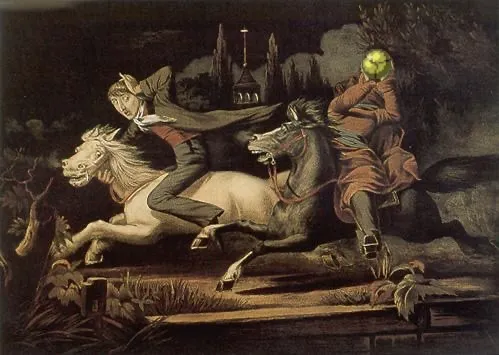
The season changed last week. The wind kicked up, the clouds blanketed the sky, and our subtropical summer briskly gave way to seasonally and historically appropriate temperatures. It’s colder on the top floor of my pre-war apartment building where the wind howls through the stairwell and the breeze breaches the windows, and so I feel in my bones that it is time to go apple picking. It is time to get tickets for Hanif’s annual show. It is time to listen to History Books and make chili. It is time to reread The Legend of Sleepy Hollow.
It’s been kicking my ass this year. I’ve read two pages a day, tops. The 200-year old grammar and syntax, always a hurdle, has become a wall. And I just haven’t been able to read much at all this past week. The books I’ve been working through each day are piled on the coffee table. My focus isn’t there. Still, I persist. Most things worth reading, to me, have been challenging. Slogs, even. The classics I liked and disliked in AP Lit. The theory books I bought for class or because they were on sale in 2020. The novels and collections I checked out when another writer recommended them. There are exceptions, of course. Sometimes books are easy to read, comprehend, and remember—in nonfiction because I feel the author is reconciling my own unanswered questions, in fiction because a narrative is thrilling or a romance intoxicating. Other times I even enjoy the struggle. Such with Washington Irving, a linguistic, temporal, and cultural foreigner I relate to purely through geography and a mutual appreciation for the season.
I also tried playing Super Metroid on the 3DS’s Virtual Console this weekend. I swear that, after getting the Morph Ball and Missiles, I went up the elevator and nothing happened. It was only after exhausting every other action I could think to try twice that I phoned a friend. I went back up the elevator. Pirates were there now. My game continued… Until I got stuck down a pit, a tunnel full of alien bats leading to a locked door I couldn’t open. I shot lasers. Rockets. Jumped. Morph balled. I looked up a guide: Shoot the red doors with five missiles. Of course! If something doesn’t work, I should simply try doing the same thing again, even more.
It was here that I knew I would only get through this game with a guide. And while the exploration, atmosphere, and action would all be the same, I felt I would deny myself the game’s puzzles and mysteries, challenges I found more interesting, discoveries more rewarding, than just fumbling around in the air trying to avoid acrobatic space pirates. My second attempt at Metroid had gone worse than my first. At least I wasn’t being paid to tell the internet my opinion about it this time.
You can follow my work by email or RSS feed and support my writing through Ko-fi.
But why does playing with a walkthrough feel like it undermines play? Why do I refuse to approach a difficult game with some study aid and the perseverance I do texts? The former might be answered in the pages of one of those books sitting on my coffee table.
In The Score, C. Thi Nguyen contrasts the ’object beauty’ of traditional media and art with the ’process beauty’ of games, cooking, music, and sport: “In the traditional arts, the beauty is in the art object itself. It’s in the painting, the song. It’s in the sculpture that’s radiantly gorgeous, that novel that’s bittersweet and moving. But in games, so much of the time, the beauty shows up not in the game but in the player. Games help mold, shape, and heighten beauty in the player’s own actions.” There’s a lot I appreciate about The Score, vocabulary and observations that help me articulate why we play games, but I fundamentally disagree on this point. There is process beauty in all art. I have felt moved and disoriented standing before monumental modern art like Vir Heroicus Sublimis. I have felt my life affirmed by letting a movie like The Boy and the Heron guide my thoughts with it sights and sounds for two hours.
Learning about modern art can help me appreciate Barnett Newman, trying to cast The Boy and the Heron into the mold of Hayao Miyazaki’s career can be diminishing, and playing Super Metroid with a walkthrough feels a bit like when I first started reading theory for Dr. Wheeler’s classes. Coming to class, having no idea what I read beyond a string of words, then working through Debord sentence by sentence together. I didn’t know what I was learning that semester until long after I had learned it—until I could read theory by myself, slowly still, but independently. Until I could pick up any novel I found daunting to broach in high school and know it was a matter of time, and maybe some effort, to read the prose. At the culmination of my undergrad, I had grown used to the syntax of translated Greek in Aristotle and Plato. Contemporary YA novels and lit fic felt easier to read when I began reading more for pleasure. But now I had bigger questions—of craft and theme. And to this day, I feel like I’m still trying to read at that level. Could I ever play Metroid like I read Irving? Maybe. I’d like to play Ravenous! I could play Dread on my own, after all, but I didn’t like it. What did laboring in Dread produce? Who would I be at the end of playing Super Metroid?
I like to look at books. Or, I like to think that I am the kind of person who spends more time looking at books and less at screens than I really do. I don’t really care about being a person who is good at Super Metroid or retro videogame logic, who has played all the hits like someone who’s read the classics. I know from playing Shadow of the Ninja with Cole that, like reading old texts, it would make me better at playing games old and new. But right now? I just don’t really want to juggle a second screen.